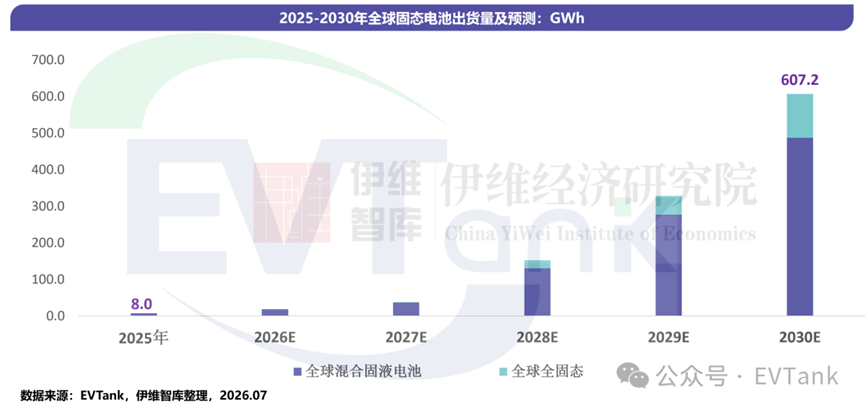
Recently, the research institution EVTank, jointly with the Ivai Economic Research Institute, released the "White Paper on the Development of China's Solid-State Battery Industry (2026)". The white paper points out that in 2025, hybrid liquid‑solid batteries were the first to cross the industrialization tipping point from “samples to products”. With mass deliveries of models such as the SAIC MG4 and NIO’s 150 kWh battery pack, global solid‑state battery shipments reached 8 GWh in 2025, up 51.9% year‑on‑year.
Entering the first half of 2026, the industry has entered a critical “pre‑mass‑production” accumulation phase. Multiple companies have announced that hybrid liquid‑solid batteries will be mass‑produced and installed in vehicles in the second half of 2026. China’s first national standard for automotive solid‑state batteries, GB/T 43568, officially took effect in July 2026, for the first time establishing clear technical boundaries with quantitative indicators:Liquid electrolyte content >20% → Liquid battery5% – 20% → Hybrid liquid‑solid battery<5% and passing the 120°C vacuum baking for 6 hours with a weight loss rate ≤0.5% → All‑solid‑state battery
Currently, all shipments are hybrid liquid‑solid batteries, which are scaling up across multiple scenarios including power batteries, energy storage, and low‑altitude economy. China’s leading position in the global solid‑state battery industry continues to strengthen. EVTank projects that by 2030, global solid‑state battery shipments will reach 607.2 GWh, with a compound annual growth rate (CAGR) exceeding 130%, of which all‑solid‑state batteries will account for nearly 20%.
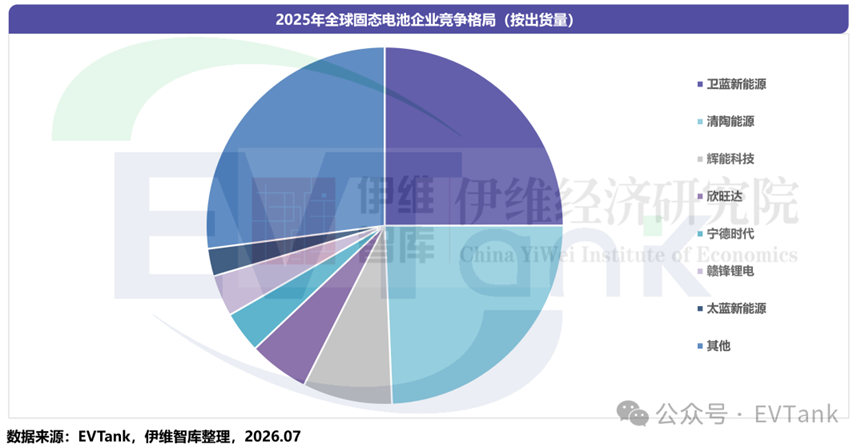
By Enterprise Shipments – In 2025, WeLion New Energy and QingTao Energy continued to lead, together accounting for nearly half of the total market share. They were followed by ProLogium Technology, Sunwoda, CATL, Ganfeng Lithium Battery, and Talanx New Energy. Among these, WeLion, QingTao, CATL, ProLogium, and Talanx focus mainly on power batteries, while Sunwoda primarily serves the consumer battery sector. EVTank believes that although newly established players dedicated to solid‑state batteries currently hold a market lead, traditional liquid‑battery giants, with their ongoing R&D and technical reserves in solid‑state technology, still have the opportunity to capture higher market positions in the future, leveraging their complete upstream‑downstream supply chains and economies of scale.
On the Cost Front – As hybrid liquid‑solid battery production capacity stabilises, yields gradually improve, and technology matures alongside rising market demand, economies of scale are becoming evident. The cost‑reduction path is clearer, and BOM costs are expected to gradually approach parity with liquid batteries. For all‑solid‑state batteries, according to the latest mass‑production plans announced by various companies, pilot lines for all‑solid‑state batteries are being intensively put into operation, and key material costs continue to decline (e.g., sulfides have dropped by over 35%). Small‑batch production is expected to begin in 2027, and the next two years will be critical for breaking through technical bottlenecks, as all players race to secure strategic advantages in the next‑generation technology.
The industry has formed a clear roadmap:2026 – Competing on production lines and validation;2027 – Competing on vehicle integration and demonstration;Around 2030 – Competing on large‑scale commercialisation.